

News
Championing inclusive PPE in Welsh theatres: How Morriston nurses are leading change
As the RCN launches its new Inclusive Personal Protective Equipment for a Diverse Nursing Workforce position statement at Congress, members across the UK are sharing their experiences of personal protective equipment (PPE) that simply doesn’t fit the workforce it is meant to protect.
Connect with us:


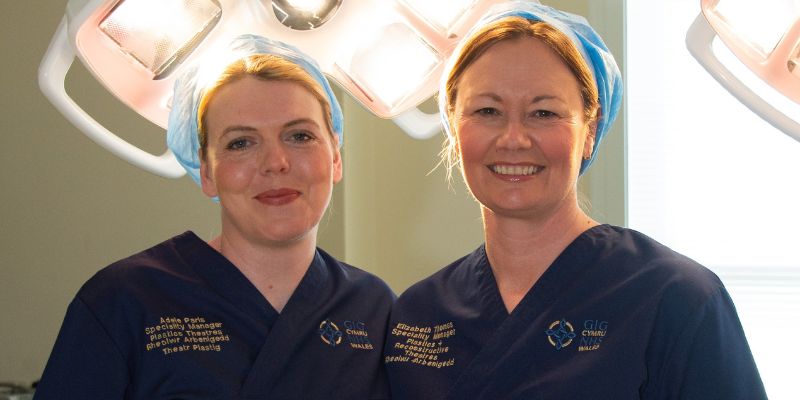
For two senior nurses in Swansea, this issue is something they confront daily in the Plastics and Reconstructive operating theatres at Morriston Hospital.
Adele Paris and Elizabeth Thomas manage the theatres together, supporting a multidisciplinary team of operating department practitioners, nurses, surgeons and anaesthetists. Their staff rely on radiation protection lead gowns every day. But for many – particularly women – the equipment available has not been providing the coverage or protection they need.
“The tabard style lead gowns don’t give sufficient coverage of the upper outer quadrant of the breasts or the axillae,” they explain. “They don’t contour to women’s bodies. When PPE doesn’t fit properly, it rightly causes concern among the theatre team.”
For Adele and Elizabeth, this wasn’t something they were willing to ignore. As line managers, they felt a clear responsibility to ensure every member of staff, regardless of their shape, size and body type, had access to safe, properly fitting PPE.
“We’ve always trusted that what we have available is correct,” they said. “But when we realised the gowns weren’t meeting the needs of our team, we knew we had to act.”
Their response became a model of proactive, inclusive leadership – exactly the kind of action the RCN’s new position statement calls for from employers, manufacturers and regulators.
Together, Adele and Elizabeth:
• explored all available PPE options, asking suppliers directly whether they offered gowns that provided full breast and axilla coverage
• sought expert advice, with suppliers recommending a wider range of styles and sizes, including wrap around gowns and Mammo-shields
• networked with other departments to understand what equipment they used and why
• arranged safe fit training so staff could understand what good PPE fit looks like
• organised a three day fitting session with a lead gown company representative to measure as many staff as possible
• introduced PPE fit assessments, enabling staff to report what was and wasn’t available on a day to day basis.
While made to measure gowns weren’t an option, they have ensured the department now has the funding to be able to procure enough sizes and styles so that every member of staff can choose equipment that fits them safely.
The challenges faced in Morriston reflect what RCN members across the UK reported during the COVID-19 pandemic – and continue to experience today. PPE has too often been designed around a default male body, leaving a predominantly female and diverse nursing workforce inadequately protected.
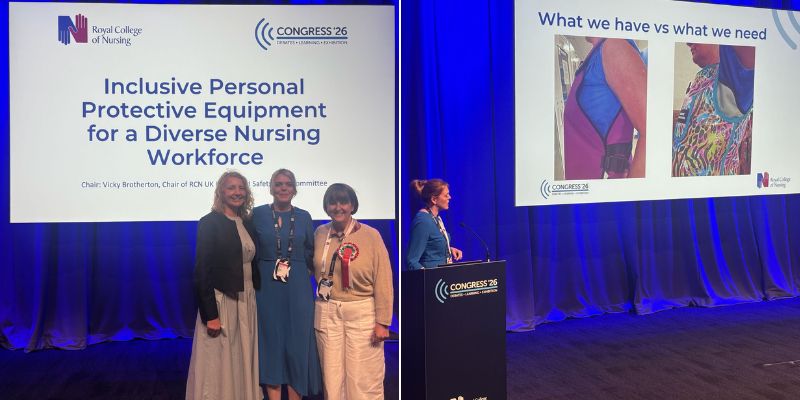
RCN Wales Executive Director Nicola Williams, Adele Paris and RCN Wales Board Chair Jackie Davies at RCN Congress 2026.
The RCN’s new position statement highlights this systemic issue and calls for urgent action from manufacturers, suppliers, regulators and employers. Adele and Elizabeth’s work shows what can be achieved when local leaders refuse to accept ill fitting PPE as “just the way things are”.
Their message is clear: inclusive PPE is not a luxury – it’s a fundamental requirement for safety, dignity and equality at work.


