


Nursing is a female-dominated profession. Yet female nursing staff are still finding their uniforms aren’t always made for them.
Instead of being purely cosmetic or just frustrating, this can have worrying health consequences. In one stark example, the British Orthopaedic Association shares that 1% of breast cancer cases can be attributed to ionising radiation. Personal Protective Equipment (PPE) not being fit for purpose is one factor that puts wearers at higher risk of this.
So, a theatre nursing team in Swansea have taken matters into their own hands. Although they’re still waiting on funding from their trust, here they highlight the steps they’ve taken so far.
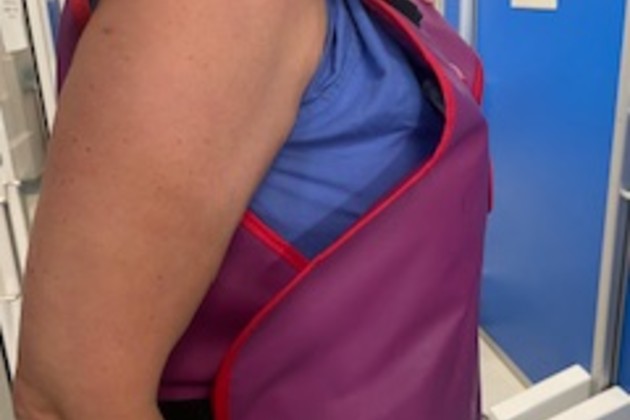
In 2025, Adele, Speciality Manager in plastic and reconstructive theatres, was at work in ortho-plastics surgery. It was a typical day until she noticed the upper outer quadrant of her breasts and axillae (armpit) weren’t covered by the lead gowns provided. She was shocked, having always trusted that they were safe. This was especially concerning as they were designed to protect against radiation, crucial due to staff’s proximity to ionising beams.
Adele and Elizabeth encouraged colleagues to try on different sizes of the tabard-style gowns, but none seemed to contour to the women’s bodies.
This presented two problems. The inadequate protection for female staff exposed to radiation in theatre, and lack of a sufficient number of gowns for teams – there are only eight gowns in total – two small, two medium, two large and two extra-large.
This isn't enough for everyone, as on any given day, the department can need up to 36 lead gowns across four operating theatres, so they had to borrow from other hubs.
The team realised they needed to get to work on two missions – to educate on which uniforms fit correctly, and to get enough of them into their workplace.
The right form of uniform
Alongside co-manager Elizabeth and RCN health and safety rep Jackie, Adele explained the situation to her theatre matrons. With their support, the three asked the lead gown company what products they had specifically for women’s bodies, and the company suggested something that would best protect the axilla and upper outer quadrants.
This elasticated, adjustable breast and axillary shield is meant to move with who’s wearing it, compatible with waistcoat-style gowns.
They spoke to a senior sister over the border in England, who had bought this design for every female member of her staff.
“Next, we shared our concerns with consultant surgeons, anaesthetists and radiologists, outlining what we needed and why,” recalled Adele.
“They were supportive. A radiology clinical scientist observed the current gowns’ suitability, and the department suggested we should buy enough lead gowns in various styles to adequately protect all our staff. We calculated this ourselves, as well as distributing Radiation Protection PPE Self-Assessment forms.”
The wider team has 50 plastic surgery consultants and registrars, 22 plastics theatre staff, and other nurses, medical students and operating department practitioners in various specialities such as anaesthetics.
- Read next: Looking after your own health
But after four months of creating tables, hosting fitting sessions, completing a risk assessment and ensuring the findings were added to the theatre risk register, the campaigners requested a quote from the gown manufacturer. It came back as more than £30,000 for sufficient stock in a range of styles and sizes compatible with a variable work force.
PPE post-COVID
Although the COVID-19 pandemic shone a light on the importance of PPE, it hasn’t always stuck.
Staff don’t necessarily understand the need for correctly fitting PPE, or the long-term health implications of not wearing it.
Others, however, will have felt the moral dilemma of refusing to care for patients who need limb-saving surgeries, or wearing lead that didn’t fit them.
The operating theatres are organising training with radiology to improve education and attitudes to ionising radiation protection, while they wait for their trust’s new financial year. They hope this will bring the funding for the correct PPE.
If you spot a similar issue in your workplace, make sure to speak up. You can inform colleagues if their PPE doesn’t fit, suggest how they change it, and remind them that radiation exposure is cumulative, with poorly-fitting aprons reducing protection.
Although nursing staff care deeply about the health and safety of their patients, their own is crucial, too.
As a practical tip, rep Jackie recommends others take evidence to their health board, perhaps via audits undertaken over a specific timeframe. “Don’t be afraid to network with colleagues in specialist units and ask how they do it. Follow risk assessment processes, enter results in your department’s risk register, and document examples of unsafe practice using your health board’s incident reporting system,” she advises.
What now?
Louise Church, RCN Head of Health, Safety and Wellbeing, says: “This is a powerful example of members organising around an important health and safety issue. Inclusive PPE is essential if women are to be properly protected at work. By working with their RCN health and safety rep, members turned real concerns into action to support women’s health, safety and wellbeing at work.”
Earlier this year, the RCN also published a position statement on inclusive PPE for the diverse nursing workforce we represent. As well as being largely female, this encompasses many ethnicities, religious beliefs, and disabilities.
The statement reads: “We cannot wait for another pandemic to ensure equity of protection. PPE should fit the nursing workforce, rather than the nursing workforce having to fit the PPE.”
And as Adele’s own mission continues, she hopes to encourage others around the UK to speak up if their PPE is raising questions.
Find out more
- How the RCN supports nursing teams.
- Your guide to raising health and safety concerns.
- Prioritising personal safety at work.