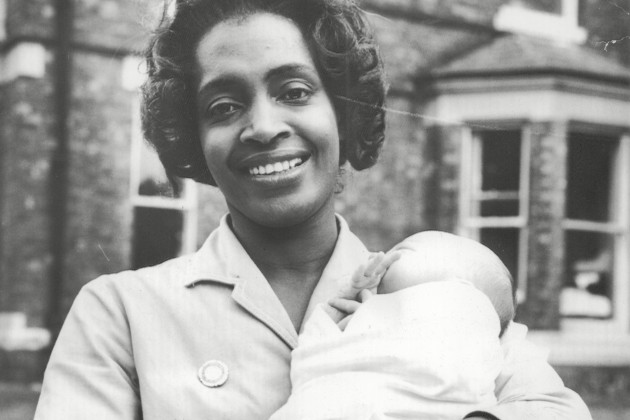


A lot has happened since Lorna Finlay joined the RCN 76 years ago, during her first week working as a nurse.
The RCN – the College of Nursing as it was known at the time – was founded in 1916, just 11 years before she was born.
“I didn’t really have a choice about joining,” she remembers. “On my first day of training, the ward sister stuck a form in front of me. ‘Sign that and give me 10 shillings,’ she said. That was my membership for the year.”
Back then, the RCN looked quite different in some ways to its modern incarnation. Lorna joined before men were allowed to be members.
“I'll admit, I wasn’t happy when men were first allowed to join the RCN. I remember thinking it ruined the whole ideal. But the longer I’ve lived with it, the more it’s become clear it was the right thing to do,” she says.
A chance to get away from home
But Lorna nearly didn’t become a nurse at all.
There was no free secondary education after age 15, so the options for working class children were limited. Lorna wanted to be a teacher but that was out of the question.
When her mum became ill, 14-year-old Lorna had to leave the technical college to help around the house. It was then she decided she needed to find a job.
I needed to get out of the house and the only thing I could think of was nursing
Her first role was as a dairy maid apprentice, where she was paid 7/6d (seven shillings and six pence, in imperial currency, used in the UK before decimalisation was introduced in 1971) a week.
She quickly rose through the ranks there and before long was working in the office. Although she had the chance to progress further, it never happened because Lorna’s dad wouldn’t let her go to college until she was 21. For someone with a love of learning, this was deeply frustrating.
“As a dairy maid, I saw another side of life. I needed to get out of the house and the only thing I could think of was nursing,” she says.
The best choice
Lorna may have started nursing to escape from the constraints of home, but her first training role in February 1950 didn’t bring complete freedom.
“The hospital rules and regulations were even more strict than what I’d faced before,” she remembers. “I had to be back by 10pm, but nursing gave me a way to keep going. You were always sure of your food, and you had a roof over your head. It was the best decision I ever made.”
The training Lorna received may look completely different to the training nursing students have today, but it gave her a career path from which she never looked back.
“Initially a lot of my work was domestic cleaning, not nursing. But the teaching was quite good if you were with a good ward sister. On my first ward, I learned how to give an injection and an enema, and how to tube feed someone with paralysis.
“Lectures were all on your off-duty days and first thing in the morning, whether you’d worked the night duty the night before or not.”
Nursing in a polio epidemic
The famous sugar lump polio vaccine was still a few years off when Lorna was training in a fever hospital just outside Belfast.
“I was assigned to the polio ward on my first day. I was vaccinated against common diseases of the day, but not polio,” Lorna recalls.
Polio was a brutal disease. Many patients died of paralysis of vital systems. Survivors might be left with lifelong residual muscular and skeletal complications.
Lorna remembers some patients enduring severe muscular pain, especially in their legs. Pain relief wasn’t given in case it masked respiratory failure.
“We used wet packs made of old blankets wrung out in hot water on patients’ legs to help them,” she says. “They were changed hourly where possible, but I thought these packs would make patients more uncomfortable when they cooled off.”
There were several patients with various stages of polio on the ward, including two on artificial respiration – the so-called iron lung.
“When I first started, I remember being fearful of going to that end of the ward in case I caught the disease, even though I knew the offending organism was ingested, not inhaled.
“The chief medical officer had told us that if we became infected, he would be unsympathetic since the fault would be ours because of inadequate handwashing. Disposable gloves had not yet arrived.”
What’s an iron lung?
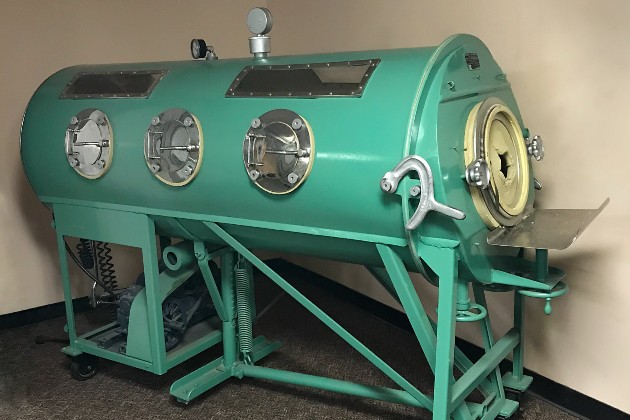
The iron lung was a large metal ventilator that surrounded the patient’s body, leaving only the head and neck outside. A sealed collar kept the chamber airtight.
An electric pump changed the air pressure inside the machine, causing the patient’s chest to rise and fall so they could breathe. The machine made a steady pumping sound, and staff were taught how to work it by hand if there was a power cut.
During Lorna’s first six weeks of her training there was a fresh outbreak of polio. Many seriously ill patients were admitted over one weekend, including two senior nurses from other hospitals who had been on holiday in an infected area.
Nursing patients confined to the iron lung was physically demanding.
“For nurses giving routine care, this meant stopping the bellows, pulling the patient out and working at speed,” Lorna recalls. “We often had to work in short bursts, returning the patient for assisted breathing if distress became obvious.”
While the devastating impact on patients being treated in an iron lung is well-documented, the consequences for those nursing them is less well-known. Lorna’s fear of passing oesophageal tubes remained with her throughout her clinical career. These tubes are used to deliver food or fluids directly into the stomach when a patient can’t swallow.
It’s impossible to imagine how frightening and uncomfortable it must have been for patients in these metal prisons
“Oesophageal tubes were not left in situ and re-passing them each time was a nightmare as it was almost impossible to be sure they were in the stomach and not the lung,” she says.
“I was always supervised by a more senior nurse but it’s impossible to imagine how frightening and uncomfortable it must have been for patients in these metal prisons.”
Lorna’s patients were usually young, but parents were generally not allowed to visit their children, in case it upset them. When visiting was permitted it was restricted to one hour, two days a week, and then parents could only smile or wave through glass doors or panels.
“I remember one teenager lying there, completely paralysed. He became abusive to the nurses, and he was told off by the consultant. There was no understanding of what he was going through. Children who wet the bed were scolded without consideration of how they might be feeling about being separated from their parents too.
“I never questioned this,” Lorna says. “Nurses then were taught to keep a professional distance rather than talk to patients or allow them to express feelings and fears.”
The introduction of a polio vaccine in the mid-1950s led to a dramatic decline in cases and today polio has been almost eliminated across the globe.
A career to be proud of
Lorna’s extensive nursing career took her to cardiology, midwifery, post-anaesthetic recovery, surgery, community nursing, health visiting, and her original ambition – teaching – as a respected tutor at the RCN. However, it’s Lorna's time in cardiology that stands out for her.
“I spent my six most stretching, most exhausting years in cardiology, from 1958 to the middle of the sixties. It was the most exciting time in my nursing career. There were developments in science and cardiology with a big expansion in cardiac surgery. I was teaching student nurses as well.”
Lorna nursed the first open-heart cardiac surgery patient in Northern Ireland but first went to Guy’s Hospital in London to see how it was done.
“I observed the operation in theatre and couldn’t believe what I was seeing. This young boy was effectively dead on the table and yet made a full recovery. It was mind-blowing.”
I’ve seen almost unbelievable scientific developments
When Lorna returned to the Royal Victoria Hospital in Belfast, the surgery took place in a clinical area at the bottom of a ward.
“I loved cardiology, but it was quite a different time. Up until then we had sent patients across the water. But we had 30 people on our waiting list. Our first 10 survived and did very well.”
No regrets
There have been enormous changes to nursing practice in the last 75 years but for Lorna, the drugs and techniques available from the 1960s onwards stand out as groundbreaking.
“The sixties were exciting times. I’ve seen almost unbelievable scientific developments, after decades of nursing hardly changing. I was fortunate to work during a period of great change in the teaching and nursing world. It's important for all nursing staff to know our history and I've been active in the RCN History of Nursing Forum throughout my retirement.”
Does Lorna have any regrets?
“Absolutely not,” she says. “Nursing is the best thing I ever did. It was the right decision for the wrong reasons. It opened a whole new life for me. It’s given me everything I ever had, and I would do it all again.”
How has the RCN changed since Lorna joined?
- 1960: We open our membership to all registered nurses, including men.
- 1962: We launch our first public pay campaign, following a fall in nurses' wages to 60% of the national average salary and a freeze on public sector salaries.
- 1963: We join the National Council of Nurses to become the Royal College of Nursing and the National Council of Nurses of the UK (RCN).
- 1968: We open our membership to nursing students, allowing them to become full members for the first time as part of the student nurses' section.
- 1976: We register as a trade union.
- 1984: Our linked hands logo is introduced.
- 1995: We change our rules to allow industrial action.
- 2011: We admit health care assistants (HCAs) into full membership.
Read more about our history and join the RCN History of Nursing Forum.