

Dame Jasvinder didn’t read a book until she was 28; she experienced poverty, domestic abuse and estrangement. She also single-handedly set up a national charity; her book Shame – described in the House of Lords as a political weapon – became a Sunday Times top-10 bestseller; and in 2024 she was awarded a Damehood.
She talks to RCN Magazine’s Claire McKinson about the power of saying no, her extraordinary career in advocacy and where nursing staff can find advice and support if they suspect forced marriage or honour-based abuse.
You've dedicated your career to fighting for others. What's been your motivation?
I was born in the UK to Indian Sikh parents and one of the things I learned at a young age was how much my life differed to my peers. My six sisters and I were raised with one expectation – that us girls would become wives.
Aged 14, my mum sat me down after school one day and showed me a photo of the man I was to marry – a man I’d never met but I learned I’d been promised to from eight years old.
My parents stopped me going to school. I was held prisoner in my own home
Unlike my older sisters, who, at 14 were told they were to marry and were taken out of school – I refused. I was bright and I enjoyed school, I saw how my married sisters suffered, saw their bruises and I didn’t want that for myself.
Saying no was pivotal in shaping your career, but what impact did it have on you?
To refuse was to bring shame and dishonour to our family.
My parents stopped me going to school. I was held prisoner in my own home and shut in my room, which was padlocked from the outside. I took an overdose in the hope my parents would take me to hospital, and I could tell someone what was happening. Instead, they kept me at home and plied me with coffee.
I knew if I agreed to the marriage, the door would be unlocked, and I could plan my escape. I ran away aged 16. I believed I had the right to an education and to choose who I wanted to marry.
My children and grandchildren will never inherit such legacies of abuse
That was the point I was trying to prove. And I always believed my parents would recognise that and welcome me back. Instead, they told me if I didn’t honour this promise of marriage, I was dead in their eyes.
I decided not to go back, and my family disowned me. It’s been difficult, I’ve missed them terribly, but I don’t regret my decision – my children and grandchildren will never inherit such legacies of abuse because of the choice I made at 16.
Forced marriage: the indicators
Forced marriage is a criminal offence, and it's now illegal to be married under the age of 18 in the UK.
Honour-based abuse can affect men, women, children and young people from many cultures, religions and communities. Common signs include:
- emotional and psychological pressure: are they withdrawn, anxious or depressed. Do they self-harm or have suicidal tendencies?
- restriction of movement: are they accompanied to appointments and do family members refuse for them to be examined alone?
- threats and intimidation: are they reluctant to talk about family life? Is there a history of unwanted or concealed pregnancies?
- being made to feel like they're bringing shame on their family: have they recently become very religious? For example: suddenly wearing a head covering?
- isolation from friends: are they restricted to who they can talk to or mix with? Are they allowed to attend school regularly?
- monitoring and surveillance: do they have access to a mobile phone or the internet, their birth certificate or passport, etc?
- being at risk of being taken overseas: this is usually disguised as a family holiday, wedding or visiting a sick relative
- physical violence: do they have injuries which cannot be reasonably explained?
One indicator alone may not be significant, but a pattern of behaviours should always prompt professional curiosity. If you suspect a patient could be a victim of honour-based abuse, reach out to Karma Nirvana or the Forced Marriage Unit for confidential advice and guidance.
Never approach or contact the patient's family. This can put the patient at significant risk of harm. The patient may believe their religion or culture support these practices. This isn't true; and they'll need support to understand this, and your help to access a helpline while in your care.
What led you to opening the award-winning charity, Karma Nirvana?
When I was 24, my older sister Robina, who was in an abusive marriage, died by suicide. I was told by my mum that I could only mourn alongside my family at night, when no one could see my face. Even in those awful circumstances, my mum was still concerned about the shame my presence would bring.
I realised in that moment, if Robina’s death couldn’t make my parents understand how wrong the honour-based system is, nothing would. Instead of waiting for acceptance that would never come, I went back to college, then on to university, and I found my voice. I started talking about mine and Robina’s experiences.
Nobody was talking about forced marriage in England in the 90s
In 1993, I founded Karma Nirvana in Robina’s memory, to help other women and men affected by honour-based abuse. I launched a national helpline from my front room and now it takes around 1,000 calls a month. Last year, the charity successfully campaigned to increase the age of marriage in England and Wales from 16 to 18.
Was it a difficult landscape to start campaigning in?
Nobody was talking about forced marriage in England in the 90s. The attitude was "that doesn’t happen here". I wanted to start reporting on this abuse, but I had no support from my community – they saw me as a threat.
Around the same time, I became a fitness instructor and started a women’s health group in Indian, Pakistani and Hindu community centres. Eventually, women would come and talk to me after the class about their problems and their relationships, and I slowly started to support some of them through the charity.
Some of my biggest early allies were nursing staff
I found volunteers (women who'd come through my fitness classes), I begged for platforms to speak and then I started to lobby parliament. I worked with seven different prime ministers, holding them to account over making forced marriage a criminal offence. Some of my biggest early allies were school nurses, health visitors, midwives and nursing staff working in GP practices and primary care.
Forced marriage was made illegal in the UK in 2014. But what work still needs to be done?
People assume it’s just the older generation who are perpetrators. That’s not true – this crime is being committed by younger generations and by family members with professional jobs too. But there are hardly any convictions of forced marriage despite it being so prevalent. We’re not seeing people being held to account. That must change.
We know people most at risk are aged between 5 and 18. I’d like to see it made compulsory for schools to put up posters with a helpline number, and for there to be discussions about these issues in assemblies and lessons. There are children growing up now who are conditioned to believe forced marriage and honour-based abuse are okay.
What would you like nursing staff to understand about these issues?
Nursing staff are crucial to the fight against forced marriage, female genital mutilation and honour-based abuse. If you’re in a health care setting and you have an inkling that something isn't right, explore it.
It’s important you’re empowered to question any concerns without worrying you’re being culturally insensitive. Forced marriage isn’t tradition – it’s abuse, and it’s a safeguarding issue. Cultural acceptance doesn’t mean accepting the unacceptable.
It's not just Asian communities that are affected. And it's not just women
These abuses aren’t supported by religion either, and all major faiths support this message. Sadly, we don’t hear this enough from the leaders in the very communities where these abuses are happening.
In the UK, it’s not just Asian communities that are affected. And it’s not just women. About 20% of callers to the Karma Nirvana helpline are now men, predominantly gay men, being forced to marry to hide their sexuality.
What support is available to nursing staff who have concerns?
If you’re concerned that someone might be the victim of a forced marriage, child marriage, or honour-based abuse, there’s a raft of tools to support nursing staff.
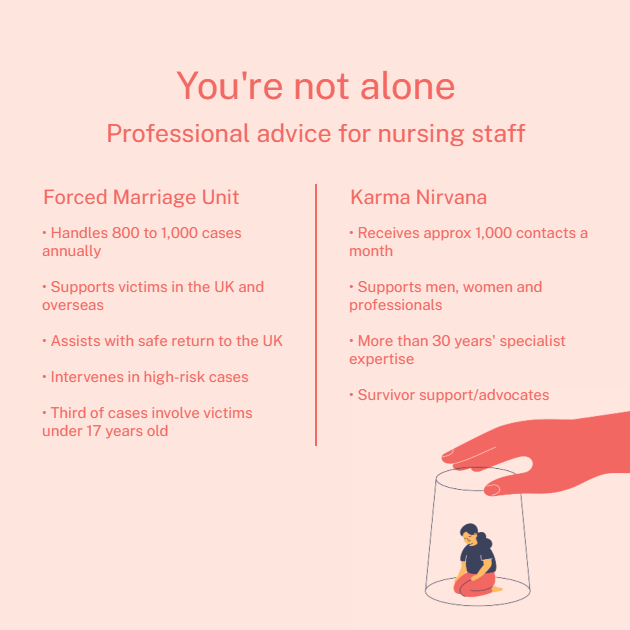
More than 40% of callers to the Karma Nirvana helpline are professionals seeking advice and guidance – whether that’s help with identifying honour-based abuse and evaluating risk factors, to advice around safety planning and guidance around law. There’s also the government’s Forced Marriage Unit, statutory guidelines for health, and civil and criminal law behind you.
A professional intervening in the right way can significantly change a person's life. You're not just saving them, you’re breaking the legacy of abuse for generations to come too.
More information
If you need to reach out for further support, Karma Nirvana advises 1000 men, women and professionals, every month.
If you want to stop a forced marriage or need help leaving a marriage you’ve been forced into, contact the Forced Marriage Unit.


