


Five years on from Myanmar’s military coup, the country’s health system has been pushed to the brink. Hospitals have been attacked, medical neutrality violated, and thousands of health workers forced into hiding or exile. Yet nursing hasn’t stopped. It’s moved underground, sustained by extraordinary courage and international solidarity.
The RCN’s been part of this effort, supporting Myanmar nurse educators and local health leaders to develop a three-year undergraduate nursing degree and a one-year bridging programme – the first degrees of their kind developed entirely within a conflict zone.
Find out more information about the work the RCN’s International Nursing Academy is doing in Myanmar and further afield, at the bottom of this article.
As the first cohort graduate in Myanmar, we speak to two of its students, Florence and Ree Myar, about their journey, their resilience, and what this moment means for them and their country.
What first inspired you to pursue nursing?
Florence: I always wanted to be part of a profession that provides care. After the coup, everything changed – conflict, displacement, and a huge rise in unmet health needs. Many people in conflict zones had no access to safe care. I realised if I became a trained nurse, I could help my community in a meaningful way.
Ree Myar: I felt the same. Watching families flee, seeing children without medical care – it made me want to do something that mattered. I didn’t want to take a quick online course; I wanted to become a highly skilled professional nurse. Nursing is respected in our communities, and my family encouraged me. I also wanted to overcome the loss of learning opportunities caused by the conflict. Becoming a nurse felt like a way to rebuild something positive.
Before joining the RCN-supported programme, what was your experience of trying to access nursing education in Myanmar?
Florence: I was a student at a government university, but students were afraid to ask questions. Critical thinking wasn’t encouraged. After the coup, opportunities disappeared. I later found another school with a better approach, but even that became unstable.
Ree Myar: I waited for a programme where teachers believed in proper health care education. That chance finally came through the RCN-supported initiative.
How did you first connect with the underground nursing programme, and what did the RCN’s support mean for your training?
Ree Myar: I first heard about the opportunity on social media. The Phoenix Nursing programme was working with experienced Myanmar nurses and the RCN to support underground education. I applied immediately. I remember feeling so happy – it felt like a lifeline.
Florence: It was the same for me. After the coup, there were almost no education opportunities. The RCN’s support has been lifechanging. Without it, I honestly don’t know if we could have continued our training. It gave us access to proper education, motivation, and the chance to become skilled professionals.
Which aspects of the training made the biggest difference?
Florence: Access to the RCN library was incredibly important. It allowed us to study properly and prepare for lifelong learning. In addition, the RCN’s International Nursing Academy supported us with technical guidance and high-quality teaching.
Sometimes we worried we would become patients ourselves
Ree Myar: The mentorship from the RCN really stood out. It was so different from how we were taught before. Instead of just lectures, mentors helped us connect critical thinking with real-life practice. The International Nursing Academy lectures and support from Myanmar faculty, RCN module leaders and international nurses were tailored to our needs. It helped us grow personally as well as professionally.
Did working with international educators change your perspective on nursing?
Ree Myar: Absolutely. It gave me a deeper understanding of quality nursing care, international guidelines, and professional standards. It taught me how to apply high standards even in low resource settings. It strengthened my critical thinking.
Florence: Learning from international nurses broadened my understanding of the global nursing community. I realised nursing isn’t just what happens inside a hospital – it’s a worldwide profession built on collaboration. It made me feel connected, and it inspired me to grow.
Education during conflict must have been incredibly challenging. What was that like?
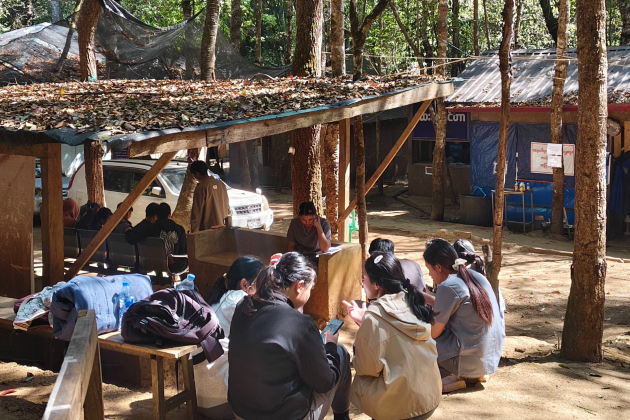
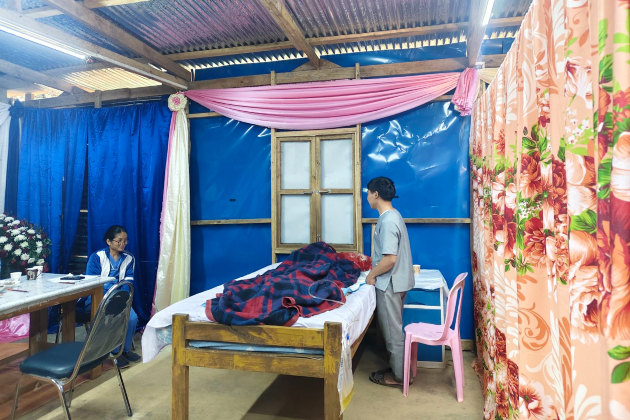
Florence: We studied in temporary shelters, sometimes in small tents in the forest with many mosquitoes. Food was limited. We couldn’t return home safely or speak to our families. Being away from them for so long was emotionally painful.
Ree Myar: Safety was always a concern. We had to be careful with social media. There were constant risks – airstrikes, heavy weapons, aircrafts overhead. We had to be ready to hide in bomb shelters at any moment. The mental stress was constant. Sometimes we worried we would become patients ourselves.
What practical or emotional obstacles did you face while studying?
Ree Myar: We didn’t have proper classrooms or equipment. Often there weren’t any desks, we had limited materials, and not enough facilitators. Sometimes classes were cancelled because of the conflict, which delayed our progress. We walked long distances to study, carrying batteries for power and searching for internet access.
Florence: The biggest challenge was the constant worry about our families’ safety. Clinical placements were difficult too – we wondered if we would be fully prepared. But these obstacles taught us resilience. Support from teachers, family, and other nursing staff gave us hope.
What personal strengths or values did you develop during your training?
Ree Myar: At first, I saw nursing tasks as procedures to complete. Over time, I began to see patients as people who are suffering and need emotional support. My care became more patient-centred. I also developed resilience – learning to adapt and keep going despite fear and uncertainty.
Myanmar nurses have an incredibly strong spirit
Florence: I learned the importance of equity in care. Every patient deserves the same respect, regardless of background. Resilience has shaped the kind of nurse I’m becoming.
How has training during a national crisis shaped your views on patient care and nursing leadership?
Florence: It strengthened my belief in holistic care. Patients in crisis suffer physically and emotionally. I’ve experienced loss myself, so I understand their pain more deeply. Nursing must address the whole person.
Ree Myar: I now listen more carefully and respond with more empathy. I also understand the importance of advocacy – especially for vulnerable people who may be overlooked. Leadership isn’t about position; it’s about responsibility and courage.
You’ve just graduated. What does this moment represent for you and for Myanmar’s nursing community?
Florence: It’s a meaningful achievement. It shows we’re ready to move forward as professional nurses. For our community, it represents hope during a very difficult time. We’re the first to receive this kind of support from the RCN, and that’s truly special.
Ree Myar: This qualification is a bridge between global nursing and our community back home. It carries responsibility – to bring back world-class knowledge and apply it ethically. It represents hope, growth, and a commitment to give back.
What message would you share with other Myanmar nursing students facing uncertainty?
Ree Myar: Reflect on your experiences. It’ll help you grow personally and professionally.
Florence: Practise self-care. Ask for help when you need it – it’s not a weakness. Don’t just collect knowledge; apply it. Your future patients need you.
What do you want people in the UK to understand about nurses in Myanmar today?
Ree Myar: Myanmar nurses have an incredibly strong spirit. Even with limited resources and great personal risk, they keep caring for patients. Many have lost homes or relatives, yet they continue.
Florence: They give so much but receive very little support. International solidarity matters. Please don’t forget Myanmar’s nurses. Your encouragement reminds us we’re not alone.
The RCN’s International Nursing Academy work
Marcus Wootton, Associate Director of the RCN International Nursing Academy tells us more.
“We’re honoured to support our Myanmar nursing educator partners as their first cohort graduates. This Myanmar‑led programme has been enriched by international academics who freely gave their time.
“Myanmar’s nursing profession has a proud history - degree education since 1991 and a nursing regulator for over a century. Despite conflict, that tradition continues.
“Since the 2021 coup, nurses have faced violence, displacement, and a collapsing health system. Many work with minimal resources as disease rises and medicines remain restricted. The RCN has provided practical support - education, clinical advice, evidence, and technical guidance to - hundreds of nurses who continue caring and teaching despite being criminalised.
“Global nursing is central to the RCN’s mission. It's one of our founding principles and in our royal charter. Nursing is a powerful expression of humanitarianism and nowhere is this truer than in Myanmar - our work does not stop there.
“Through our International Academy, we’re working in Ghana, Myanmar, Sri Lanka, the UK Overseas Territories, Malawi, and the West Bank and Gaza. Our approach is grounded in equal partnerships, offering technical, clinical, and educational support in crises and collaborating with national nursing associations worldwide.
“As the world’s largest nursing organisation, we have a responsibility to lead with a global voice.”
Find out more
Read the RCN report The Phoenix Nursing Programme: Rising from the fire


