


Warning: this article contains themes of domestic violence and abuse
"Nursing is a female-dominated profession, and unfortunately, a lot of us know a woman who's been a victim of domestic violence. That's why it feels reassuring to know that we're part of a solution,” says Grace.
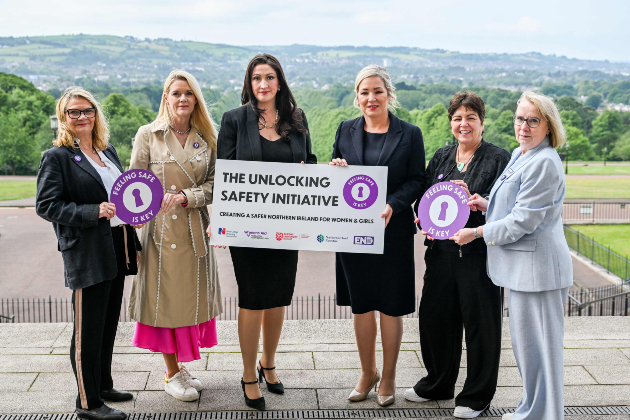
Grace – seen on the right in the picture above – is a third-year nursing student at Queen’s University Belfast (QUB). She’s one of the first people to complete a new training initiative to help nursing staff spot the signs of domestic abuse in their patients.
The RCN has played a key role in ensuring this specialist training is embedded into the undergraduate nursing curriculum at QUB, thanks to collaboration with Women’s Aid Federation Northern Ireland (WAFNI).
Domestic abuse accounts for around 20% of all crime in Northern Ireland. Of the 30 women who have been violently killed in the country since 2020, at least 21 of them were attacked or killed in their own homes.
Northern Ireland has one of the highest rates of female homicide in Europe.
The Unlocking Safety Initiative will train 600 nursing students every year, giving them the skills to recognise the signs of abuse in patients, respond appropriately to patients who disclose abuse, and to put them in touch with support services.
The difference it makes
Grace tells us that before she did the training, she didn’t realise how common domestic abuse is. And even when you’re informed, it can be difficult to identify.
“It’s under-reported, the signs are often hidden, and it can be confused with conditions like anxiety and depression. To add to the difficulty, domestic abuse is often not a patient’s presenting condition,” she tells us.
Document it, escalate it, and keep the person safe
“We’re not expected to be experts. It’s about recognising the risk and then responding appropriately.”
Students like Grace who have completed the programme will wear a badge to let patients know they can talk to them about domestic abuse.
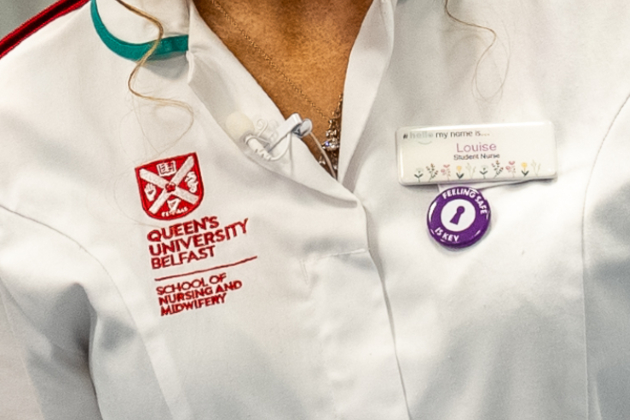
“We were taught in the training that we’re not there to investigate what’s going on. If we recognise something, our job is to document it, escalate it, and keep the person safe.”
The badge is purple – a symbolic colour for domestic abuse victims, which you may have seen on TV recently in a Coronation Street storyline.
Why students have a special role
Grace thinks students are particularly important in efforts to stop domestic abuse.
"I find that patients open up more to us because they think we have a little bit more time than nursing staff,” Grace says.
“That’s why this programme is so important in the undergraduate curriculum: because students are often the first point of contact.”
Grace’s top takeaways from the training
- Recognise the risk. This can include observing the patient’s partner, and how their children respond to the partner, too.
- You’re not an investigator. Your role is not to solve the problem by yourself.
- Listen, validate, and be discreet. This puts the patient’s needs first.
- Signpost the patient. This could be to UK-wide organisations or local ones.
- Document and escalate. Keep a record of what you’ve been told. If you’re a student, escalate the case to a senior nurse.
The story behind the programme
Of the 30 women killed in Northern Ireland in recent years, at least two of them were nurses. One was an RCN member.
That prompted our RCN Northern Ireland Executive Director, Rita Devlin, to want to do something.
“It had to be meaningful, and related to the nursing profession,” Rita says.
“As a nursing student I remember feeling helpless. I thought, ‘What would I like to have known so I could help those people?’”
Rita had recently been given an honorary professorship by QUB, so approached the university as a collaborator.
“Both Women’s Aid and QUB were fantastic partners, and the speed with which we were able to get this project off the ground was impressive.”
QUB is also running a research project to track how the training is developing nursing students’ knowledge.
I just wanted somebody to ask me and nobody did
The badge was Women’s Aid’s idea, and Rita hopes that it will become a well-known symbol for patients to know they can talk to a member of nursing staff about domestic abuse.
“Some victims of domestic violence would say: ‘I just wanted somebody to ask me, and nobody did’.
“But we also want to give nursing students the confidence to be able to ask the question themselves.
“We want to remove any stigma around questions on domestic violence. It should be a routine enquiry.”
What’s in the training?
Women’s Aid Federation Northern Ireland (WAFNI) delivers the training as part of the undergraduate nursing degree at QUB, and the first intake of students started the domestic abuse awareness element in November 2025.
The key aim of the training is "to provide attendees with an understanding and awareness of domestic abuse”, with a specific focus on different elements each year.
- First year: the impact on those who experience domestic abuse.
- Second year: how to manage disclosures.
- Third year: current legislative and policy developments.
Students also learn about common signs of domestic abuse, coercive control, and pathways to support.
The training is applicable for all nursing students, whether they go on to work in Health and Social Care (HSC, Northern Ireland’s equivalent of the NHS), independent health care, or across a wide variety of different settings and specialisms.
Sonya McMullan from WAFNI is one of the people who delivers the training. She says it’s crucial that all health care staff have these skills as the problem is everywhere.
“It’s not about a safe space,” Sonya says. “It’s about a safe person.”
‘I know what to do’
Grace says the training has improved her confidence.
“It's nerve-wracking, but a lot of our work as student nurses is nerve-wracking, because we’re still building our experience,” she says.
“If a patient tells me they’re suffering as a victim of domestic abuse, thanks to this training, now I know exactly what to do.”
Further information
- Find out more about the Unlocking Safety initiative.
- Read the RCN Guidance for Nurses and Midwives to Support Those Affected by Domestic Abuse.
- There’s more information on the RCN domestic abuse help page.
- If you need help, get in touch with an RCN counsellor.
- Read our RCN Magazine feature Domestic abuse: nursing’s silent epidemic.