


When Louise walks into the Llanfair surgery each morning, she already knows many of her patients by name. She’s an integral part of the nursing team and has seen her role change almost beyond recognition in the last two decades.
Here she explains her role and why other nursing support workers might want to consider a career in a GP surgery.
What attracted you to nursing in a GP practice?
I always wanted to work in nursing but initially devoted my life to raising my children so never trained to be a registered nurse. Instead, I started my working life in a psychiatric hospital as an auxiliary nurse, before moving to the transfusion service and then to a nursing home.
Working in a small community gives me the chance to really get to know my patients
I first came to work at the Llanfair surgery as a receptionist in 1988 before moving to the health care assistant (HCA) role in 2003, when the role was first introduced in Wales.
It was something I’d always wanted to do, and I now enjoy my work in our training practice, which has around 5,500 registered patients. Working in a small community gives me the chance to really get to know my patients.
What things do you do in this role, that other nursing staff don’t?
Every three months I work with the doctor, assisting with the minor operations clinic we run where cysts and moles are removed. Alongside providing direct care in the clinic, I also organise the appointments and, afterwards, remove stitches and work alongside a registered nurse to care for the wounds of patients that have been allocated to me. It’s good to work as a team. We work together in one room all day and it’s great to hear feedback directly from patients.
The registered nurse trained me to assist with the minor operations clinic, after working alongside her for two years. The role is now delegated to me, and I’ve been doing it for around 10 years, under their supervision. I think it’s fascinating – it’s my favourite part of my job.
What’s one thing people assume about your job that’s wrong?
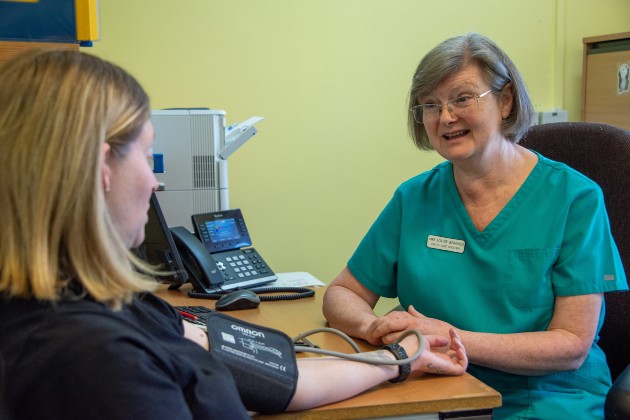
Lots of people aren’t sure what my role is. Many think I’m there to just take blood or blood pressure readings. Yes, I do this, but I also deliver care in numerous other ways. Performing tests such as these can help prevent more serious illnesses such as cardiovascular disease, and gives me an opportunity to practise health promotion.
What qualifications do you have?
I did a level 3 qualification in primary health care in 2003 and repeated the course at Swansea University in 2020 after I was advised my former qualification was no longer recognised. The practice nurse assessed me, and I was supervised in practice.
I’ve also completed courses in spirometry and wound management, alongside an Open University care in the community course.
Every couple of years, I update the skills I have where necessary. I’m fortunate to work for an employer who encourages me to keep my knowledge and skills up-to-date and supports my development.
- Read next: How to perform a simple wound assessment
What are three key qualities you need to do this job?
- Being caring.
- Not being judgemental.
- Being a good listener.
What’s most challenging about the job?
Giving dietary advice to patients who are pre-diabetic. I need to help them understand that making small changes can make such a difference. Some people want others to change them, rather than making the changes themselves, and they often want to see the changes happen immediately.
And the most rewarding?
Seeing someone get better and feel happier. Seeing the successes and making a difference – that’s what’s important to me.
What would you say to another nursing support worker who's thinking of working in this field?
Give it a go. It’s a challenging, exciting and rewarding role. You never know what the day ahead will bring but that’s what makes it such a great job.
How has the role changed since you first started?
I don’t think anyone knew what to do with HCAs when we first started here, there was some nervousness surrounding the role. Now, the whole team has confidence in my abilities.
What has kept you in the role for so long?
I do the job because I love it, not because of the pay.
GP nursing pay: what are we asking for?
The RCN has four key goals for general practice nursing staff.
- Secure dedicated government funding for their pay.
- Secure at least the equivalent of NHS Agenda for Change pay scales, terms and conditions.
- Make sure nursing is represented in negotiations on pay, terms and conditions.
- Make sure general practice nursing staff are treated equitably by their employers.
Find out more about how the RCN is advocating for fair pay for all nursing staff throughout the UK who work in GP surgeries and read how GP nursing pay is decided and what we're calling for.
You can also get support and share your experiences, knowledge and insights with other general practice nursing staff through the RCN General Practice Nursing Forum.
Photography by Stuart Fisher.


