


They don’t jump, fly, or chase. Instead, they wait.
With front legs outstretched, in a posture called “questing,” when an animal or person passes close enough, ticks climb on and search for a place to feed. They want blood. It’s that simple.
What’s slightly less simple is the disease some ticks can spread through their bites: Lyme disease. It’s the most common tick-borne disease in Northern Europe and America – and though not all ticks carry the disease, cases are on the rise.
Isabell MacInnes, a Health Protection and Screening Nurse Specialist with NHS Western Isles, has conducted research on the impact of Lyme disease on patients' quality of life.
Swift action is paramount to reduce the health risks
While ticks that may cause Lyme disease are found all over the UK, Isabell’s work highlights the experiences of those living with the condition in high-incidence locations like her local area, the Western Isles of Scotland. Other notable high-risk places in the UK include grassy and wooded areas in southern England and the Scottish Highlands.
“They’re a worldwide problem,” says Isabell. “And a member of nursing staff might be the first person to see a patient with an erythema migrans rash – often referred to as a ‘bull’s eye’.”
“This rash can be an early sign of Lyme disease and swift action is paramount to reduce the health risks,” she adds. “While the majority of people are just unwell for a short period, the important message here is that everyone – all nursing staff and patients – need to be tick-aware.”
Isabell answers questions on ticks and Lyme disease
What are ticks?
Ticks are very small spider-like creatures found in woods, areas with long grass, and sometimes in urban parks and gardens. They're found all over the UK.
A tick's life cycle typically lasts two to three years, spanning four stages: egg, larva, nymph, and adult. Once a tick bites into the skin, it feeds on the blood for a few days before dropping off. Tick bites aren’t always painful so you may not notice one until you see it on your body or clothes.
Ticks can also transfer from pets to humans.
When is the most common time of year for tick activity?
While the Western Isles of Scotland experience tick activity all year round, most places see a spring and autumn peak.
Ticks tend to be most active when the sun comes out.
What is Lyme disease?
Lyme borreliosis, also known as Lyme disease, is an infectious disease caused by the bacterium Borrelia burgdorferi, which is spread through bites from infected ticks.
What are symptoms of Lyme disease?
One of the most common symptoms is a spreading, "bull’s eye" rash at the site of the tick bite – meaning it may look like a bullseye on a dartboard (see below). The rash typically develops three to 30 days after being bitten but can occur up to three months after.
This rash doesn’t occur in all cases and it doesn’t always present as a bull’s eye. Sometimes the edges of the rash may feel slightly raised, and it can be less obvious on black or brown skin, potentially looking more like a bruise.
Other symptoms include a feeling of general unwellness: mild flu-like symptoms, such as fever, sore bones, headache and fatigue, a facial droop, nerve pains and numbness or tingling in the hands or feet.
A few people who are diagnosed and treated for Lyme disease continue to have symptoms, like fatigue, body aches and mental fog that can last for years. But most people with Lyme disease get better with treatment.
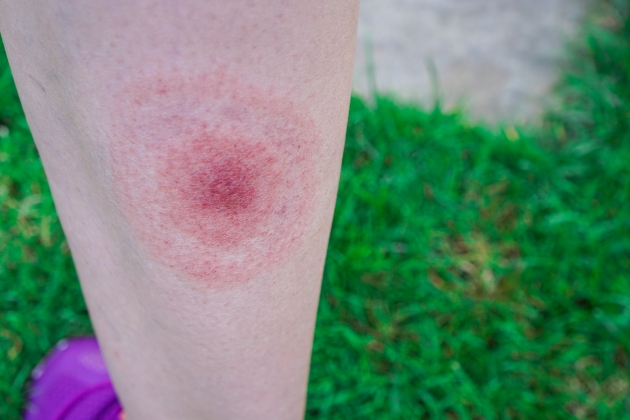
How is Lyme disease diagnosed?
There are two ways to diagnose – first is the presence of the rash and the second is a blood test.
If there is a visible rash, you don’t need a blood test.
Those without a rash are diagnosed serologically – meaning with a blood test.
People diagnosed with a blood test are more likely to experience the long-term impact of Lyme disease. It's usually easier to treat if it's diagnosed early.
Ticks can be removed safely with sharp tweezers or a tick removal tool
What is the treatment for Lyme disease?
A course of antibiotics, with Doxycycline usually being first-line treatment.
While there is a long-term impact on some people who have contracted Lyme disease via a tick bite, research shows approximately 90% of people are treated successfully following antibiotics.
The 10% who may go on to have some long-term complications often have co-morbidities.
Some people’s bodies will resolve Lyme disease on their own.
How do you remove a tick?
People can do this themselves at home.
Ticks can be removed safely with sharp, fine-tipped tweezers or a tick removal tool. This is best done as soon as possible.
When a tick attaches it needs to warm-up against the body and for the saliva from the tick to go into the blood, so there is usually a 36 to 48-hour window to remove the tick before the risk of contracting Lyme disease increases.
While removing, people need to be careful not to squish the tick’s body to avoid encouraging them to regurgitate back into the bloodstream.
Once a tick has been removed, the bite should be wiped with some antiseptic or washed with soap and water. It’s important to keep an eye on the site for several weeks for any changes.
The chances of getting ill are low. Nothing else needs to be done unless a rash appears or a person becomes unwell.
People should enjoy being outdoors: don’t be fearful, but do be aware
What role can nursing staff play in reducing cases of Lyme disease?
Be tick aware and help to raise awareness among patients.
All nursing staff have a pivotal role in educating people, and knowing about safe removal, prompt identification, and early escalation.
Being alert to symptoms is important, particularly for those staff working in primary care and emergency departments, and particularly where patients are presenting with a rash.
Remember: even if you live in an area with reduced tick activity, someone may have travelled to one. Think to ask patients: where have you been, what activity have you done?
Tick bite prevention tips
People can prevent tick bites by walking on clearly defined paths, avoiding dense vegetation, using insect repellent containing DEET and checking themselves regularly after being outdoors.
Ticks are drawn to warm, moist places; think waist, armpits, belly button, hairline, groin, and ears.
In high-risk areas, people are advised to keep exposed skin to a minimum, wear light-coloured long sleeves, and tuck their trousers into socks.
A good tip is to carry a tick-removal tool, know what to look for, and how to use it.
Find out more
- A fellowship project, which focused on preventing Lyme disease by raising public awareness, saw Isabell travel to USA, Canada, and France to meet with experts in the field of ticks and Lyme disease. Read about Isabell’s Churchill Fellowship work on Lyme disease.
- Join the RCN Public Health Forum.
- Find information for nursing staff with long term conditions on our website.
- Find out more about Lyme disease on the NHS website.
The NHS advises people to ask for an urgent GP appointment or get help from NHS 111 if you've been bitten by a tick or visited an area in the past three months where infected ticks could be, and you either:
- feel unwell with flu-like symptoms – such as feeling hot or cold, feeling shivery, headaches or aching muscles
- have a round or oval shape rash.
Tell them if you have recently been in forests or grassy areas.