


"It's just part of the job." It's a phrase many nursing staff have heard before, but violence and abuse should never be accepted as part of professional practice.
With services under immense pressure, nursing staff are increasingly encountering aggression from patients and the public.
Read on for expert advice on recognising early signs of hostility, de-escalating conflict and keeping yourself safe.
Improve the systems around you
Violence prevention doesn’t start with staff; it starts with good systems.
“Around 55% of violent incidents have a clinical cause, such as unrecognised delirium, which are potentially exacerbated by stressful situations like corridor care or excessive A&E waiting times. If those issues are addressed properly, many incidents could be prevented.
“If we're asking people to carry out highly skilled de-escalation, we need to create the conditions that make success possible,” says Dr Brodie Paterson, Chair of the European Network for Trainers in the Management of Aggression.
If your organisation's systems aren't working, raise concerns
It’s important to know that organisations are expected to identify recurring causes of conflict and put strategies in place to reduce this and protect staff and patients. The better your primary interventions, the less need there is for de-escalation.
If you feel your organisation’s systems aren’t working, raise concerns and report any incidents – it’s one of the earliest ways you can protect yourself at work.
Spot the early warning signs
Nurses Melanie McGaughey (Seni Lewis training programme lead), and Bernard Moynihan (senior mandatory and statutory clinical lead), head up training at the South London and Maudsley NHS Foundation Trust.
Their trust moved away from teaching nursing staff breakaway techniques (self-defence skills), and training now focuses on understanding triggers, the effects of trauma on people, and how to proactively meet needs before people become distressed. It's an approach that's benefiting both staff and patients.
Early signs might look like someone needing a lot of reassurance
Mel and Bernard advise that spotting early warning signs is crucial, and an incident doesn’t start when you see abusive or violent behaviour.
Early signs might look like someone needing a lot of reassurance – they might be asking you multiple questions, for example. Some patients might disengage or take themselves away from the situation. Others might get tearful, while some people become irritated.
Mel and Bernard suggest looking for telling signs, such as:
- visible agitation: like pacing and general restlessness, raised voices or speaking quickly
- large movements and gestures (although, consider if this is cultural)
- monosyllabic replies
- intense eye contact or no eye contact
- tense shoulders, folded arms, tight jaw or clenched fists.
De-escalate safely
Mel and Bernard use the Safe Ward’s Talk Down Tips tool in their trust, and Brodie recommends using the PDCA cycle (plan, do, check and adjust). They all agree that before you plan your course of action, you start by considering what may have triggered a person's behaviour.
Here are some approaches Brodie, Mel and Bernard suggest.
Understand what’s driving the behaviour
Start by asking yourself, is this person:
- distressed
- frightened
- confused
- ashamed
- or have they lost a sense of control?
Do they need reassurance, distraction or understanding to de-escalate the situation?
“Stop and consider, what’s happened to this person, not what’s wrong with them,” says Bernard.
Decide whether to stay or step away
Think about whether it’s best to stay or if it’s more appropriate to go. Remember, it’s OK to leave a situation if you feel unsafe or if you’re not feeling calm yourself.
Build rapport and reduce distress
- Create space: if you decide to stay, remember – every interaction is about reducing distress and increasing safety, not gaining control.
Consider taking the person to a quieter, less stimulating space, especially if they have sensory needs. If it feels safe, invite the person to sit down with you. Going from sitting to standing can help people feel calmer.
- Prioritise understanding: aggression is an expression of a need, so showing people that you recognise their emotions can help them feel validated and make it clear that you want to help.
You might say: “I can see you’re very upset, can we sit down and have a conversation? Let's figure out what we can do, together.”
- Stay empathetic: good communication is all about empathy. Remember that the person in front of you may be in crisis.
We always suggest asking, ‘If I was distressed, what would I like someone to do for me?’” advises Bernard.
- Find common ground: focus on working with the person, not against them.
Active listening can make sure the person feels heard, respected and safe.
“If you’re doing all the talking, you’re not de-escalating anybody,” says Mel.
Check what’s working
Continually monitor the person’s needs and the level of risk to you and other staff and patients. If it isn’t improving, it's escalating, or you feel unsafe, you don’t need to deal with it by yourself. You can leave at any time and return with a different plan.
Check how you feel, too. Being exposed to aggression can affect your emotional regulation. Is it still appropriate for you to be in that situation?
Mel says: “Too often I've seen (and I've been in) situations where you feel like you need to stay with a person because you’ve been leading their care, but it comes to a point where it’d be much better for someone else with a slightly different response or relationship to come in and take over from you.”
Is it time to adjust?
Evaluate and reflect on which techniques are working and which aren’t, to help you find a useful combination to move forward.
Stay aware of your surroundings
When paired with good communication and de-escalation techniques, situational awareness is a helpful way to protect yourself.
Here are Mel and Bernard’s top five tips, whether you’re working on a ward, a busy A&E department, in the community or another setting.
- Think about the space you’re in. Is it a small room with lots of equipment? Can you easily escape? Is there enough distance to be at arm’s length from the other person so they cannot grab or attack you?
- Are you somewhere safe? Can staff members hear you if you shout? Can you be rescued easily if the situation escalates? Do your colleagues know where you are and what you are doing?
- How are you presenting? If you’re feeling anxious or stressed, it’s harder to maintain a calm, open posture. Keep your hands visible and your arms by your side. Think about your facial expressions and your tone of voice and how they might be perceived too. It’s not just what you say, but how you say it.
- Do you need another staff member with you? A group of staff may make a person feel like they are being backed into a corner, but an extra member of staff can help you feel more comfortable and help keep you regulated.
- Consider risk factors. Assess people before you do close work with them. Using a tool like the Brøset violence checklist (below), can be a useful place to start.
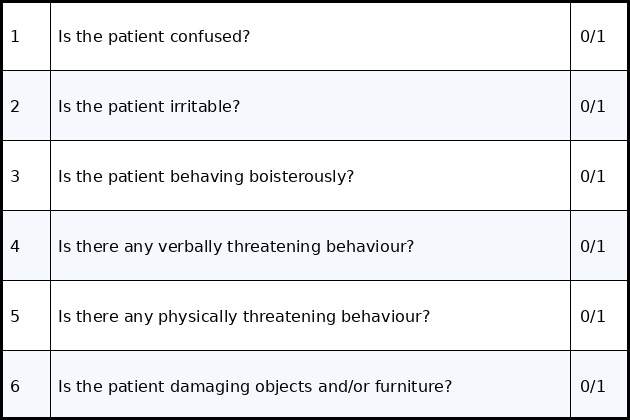
Score 0 – risk of violence is low.
Score 1 to 2 – start taking preventative measures.
Score 3 to 6 – risk of violence is high, start preventative and de-escalation measures, plan what to do if situation escalates.
Know your rights
Ultimately, under health and safety law, it’s an employer's duty to provide employees with a safe working environment. They must assess risk and put meaningful measures in place to reduce harm.
You’re legally supported by the NHS to use proportionate, reasonable and necessary force as a last resort, regardless of whether your health trust engages in breakaway training or not (if you work in the independent sector, do check your local policies). You also have the right to leave a threatening situation, or a situation where you feel unsafe.
Reporting these instances can help prevent future cases
You also have a right to report an incident to the police.
The effects of workplace violence aren’t just physical, it can lead to stress, burnout, anxiety and depression. Make sure you report any instances of aggression, threat or violence to your employer. Reporting, and learning from, these instances can help prevent future cases.
Further information
- If you’d like to know more about refusing care, employer’s liability, breaching confidentiality and how the RCN can help you make a personal injury claim, read our feature: Workplace violence: legal questions answered.
- Access our guide on violence in the workplace for further guidance and how the RCN can support you.
- Read our position statement on work-related violence in health and social care.
- We've published new guidance via the NHS Staff Council in partnership with employers and health care unions. It offers a support framework with actionable steps for staff affected by physical violence and psychological trauma within NHS settings.
- Access more information about Safe Ward’s Talk Down Tips and download the Talk Down Tips poster or access advice on how to stay open, friendly and positive.