At the end of March, I was greeted by some of my neighbours, congratulating me on my recent television appearance. Then e-mails arrived from friends that I trained with, and colleagues at the RCN and in HONF, with similar greetings and even a pretty handmade card came in the post with compliments. What had I done to appear on day-time television and be seen by such a wide range of people? Here is my story.
Until recently there was no exhibition space at Ty Maeth. I was delighted to see outline plans for an exhibition to celebrate 60 years since the opening of Ty Maeth, the RCN Wales headquarters. I was a student at the time Ty Maeth opened and remembered the fundraising activities. At the inducement of Miss Foden, the hospital Matron, I volunteered to ‘rattle a collecting tin’ in Cardiff City Centre on the Saturday of an international rugby match. Our tins were filled by French and Welsh rugby fans.
My mother and I trained at Llandough Hospital, then part of the United Cardiff Hospitals. She in 1945 and me in 1968. I have both hospital badges and offered to lend them to the exhibition. The offer was accepted and we set about plans to get the badges to Cardiff.
At around the same time, the BBC asked if there were any items at Ty Maeth which they could have on loan for a medical/nursing-based edition of the Bargain Hunt programme.
It was agreed to lend historical items relating to building’s fundraising. An amazing £300,000 had been raised in the 1960s. With my badges included in the TV programme, I was asked if I would be willing to speak about the items on loan and any other items which could be of interest. This was to be filmed as a conversation between myself and Eric Knowles, one of the Bargain Hunt presenters.
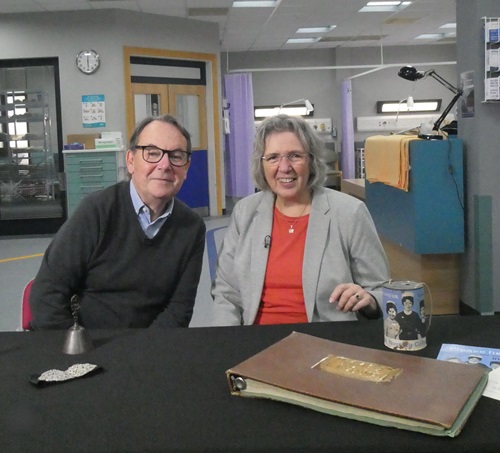
The BBC studios at Roath Lock in Cardiff Bay are used as the filming base for Casualty and were therefore identified as an appropriate venue for the recording. The set was very impressive, but because filming was underway, we could not use the ward/accident department set. As you can see below, it is quite an impressive area to film in.
In advance of the recording, I was asked to provide an overview of nursing’s history and to incorporate mention of the Ty Maeth anniversary. A script was then prepared by the BBC production team, outlining the questions from Eric and indicative responses from me. On the day of recording, staff from Ty Maeth and I met the production team and Eric Knowles at the studio cafeteria. A very practical room of long tables and wooden seats, not as fancy or grand as I had assumed. After coffee we went to the filming set, ran through the process, and all prepared to record.
The broadcast conversation was set to last about 10 to 15 minutes and took just over an hour to record. We had sight of the script guide during filming, lighting and sound were adjusted, and there were some clarification questions about the items. But there were no rehearsals, just a few re-takes. And in essence it was recorded as a single take and the BBC team were very positive about the recording.
I found it a very positive experience and immediate feedback told me it was exactly what they wanted. I had no opportunity to see the film in advance of broadcast, so was pleased to see it in March. The process for my 13 ‘minutes of fame’ took just six months, it can still be seen on BBCiPlayer and was a very positive experience.
If asked to do something similar, my advice is to be clear on exactly what is wanted of you, ask lots of questions, take your time, be sure it is appropriate and be positive.
 Share on Facebook
 Share on LinkedIn


