
Searching the RCN library catalogue for books on ‘nursing practice’ offers a dizzying 669 possible titles, some specific to a branch or single aspect of practice, but many promising to give the fundamental or essential know-what and know-how to would be nurses.
At the turn of the last century, when nursing was striving for professional status, there were less to choose from: featured here are two texts that were quick to claim they offered the complete knowledge base a probationer would need to qualify as a nurse.
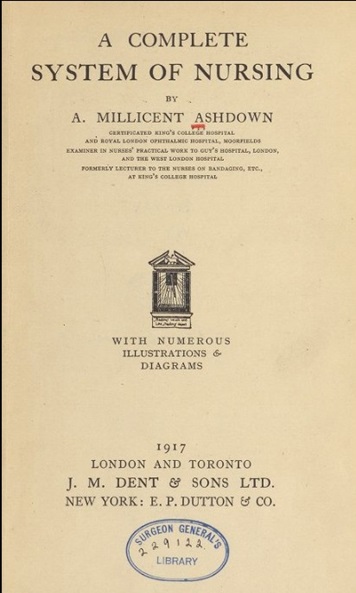
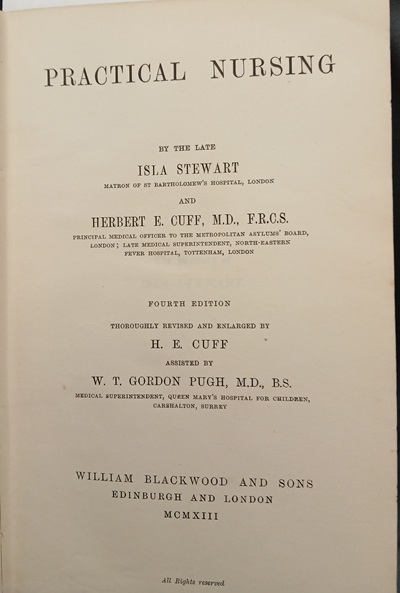
Milicent Ashdown was an experienced nurse, with certificates from King's College Hospital, where she lectured in bandaging, and the Royal London Ophthalmic Hospital, Moorfields. She was also a nursing examiner at Guy's and the West London Hospital. In 1917 she took responsibility for substantially updating and republishing an establish textbook A Complete System of Nursing, (Picture one) first edited by a respected nurse author Honnor Morten. In 1913, Dr W T Gordon Pugh, an eminent doctor specialising in children and tuberculosis, began his role in producing of Practical Nursing first published by Isla Stewart, a former matron at St Bartholomew’s and Dr Cuff, who was featured in January’s blog and who lectured and wrote textbooks for nurses (Picture two).
At first glance they are similar in content, but the focus and spirit in different, arguably reflecting a predominately medical focus for Pugh, and a nursing one for Ashdown. For Pugh, the need for the assuredly female attributes of care, obedience and observation is dealt with is a single chapter followed by general medical, surgical and nursing sections. For him a systematic, hospital-based training was an essential prerequisite to qualification and no consideration given to the world beyond a hospital ward.
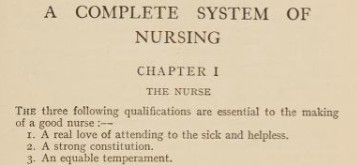
Whilst not denying the need for training Ashdown puts the women, soon to be nurse, first. She starts her first chapter with three fundamentals (Picture three), expanding on these at length, before moving on to comprehensive coverage of the nurse’s role in the management of the sickroom. Only once these foundations are laid, does she progress to a comprehensive coverage of theory and practice.
The Nurse Registration Act was not passed until 1919, but both authors were fully aware of the likelihood of a central syllabus and examination system. Their books reflected best practice at the time and continued to be core texts for years to come: A Complete System of Nursing until 1945 and Practical Nursing until the 1960s. Many thousands of nurses must have started training, nervously clutching their copies and wondering if they could ever achieve the lofty heights expected of them.
Find out more about the RCN Library historical texts and how to access them.
A Complete System of Nursing
Practical nursing
Ashdown's three principles of nursing

 Share on Facebook
 Share on LinkedIn


