
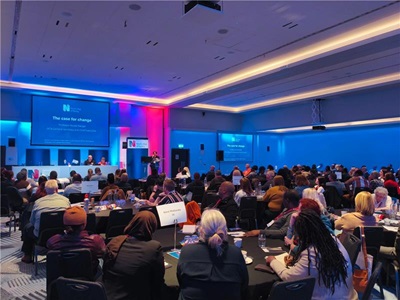
I had the privilege of attending the RCN UK Joint Representatives’ Spring Conference in Glasgow this week, and honestly, it came at exactly the right time for me. It gave me the space to pause, reflect and reconnect with why I do representative work in the first place.
There was so much to take in, but one area that really stood out was understanding how NHS pay bands are distributed across professions, and how important job matching and job evaluation are in making sure roles are recognised fairly. Hearing about the Band 5 review work in Scotland was particularly powerful, especially seeing how many roles have progressed to Band 6 to reflect specialist skills and leadership responsibilities. It really highlighted the need to raise the profile of Band 5 nurses into the Band 6 roles they rightfully deserve. Nursing remains one of the few professions where many start at Band 5 and often retire at the same band, despite taking on increasing complexity, accountability and leadership throughout their careers. It made me reflect on how much nursing has evolved and whether we are truly recognising that progression across the system.
The fringe session from the RCN Activism Academy also stayed with me, particularly in how they connect to my role within the RCN Eastern Region EDI Network. They emphasised the importance of organisation, visibility and collective advocacy, especially when addressing inequalities within the workforce. It reinforced that advancing equality, diversity and inclusion is not passive work. It requires intention, consistency and a collective voice to challenge systems and create meaningful change. One quote that really resonated with me from Martin Luther King Jr. was, “Those who love peace must learn to organize as effectively as those who love war.” It serves as a powerful reminder that EDI work, like all advocacy, requires structure, courage and sustained effort to ensure that every voice is heard and valued.
There were also important discussions around the increasing experiences of bullying, harassment and microaggressions faced by LGBTQ+ colleagues, which remain a significant concern within our workplaces. As a community, we must continue to create psychologically safe environments where individuals feel respected, protected and able to bring their whole selves to work.
Recent developments, including the Supreme Court ruling on the definition of gender and sex, have also opened up complex and often difficult conversations. While much of the public discourse has focused on single sex spaces such as toilets, the wider implications are far more significant. These decisions can have unintended consequences on the lived experiences of both transgender patients and staff, affecting dignity, access to care, inclusion and psychological safety. It is a reminder that policy and legal frameworks must always be considered alongside real human impact.
All of this reaffirmed my belief that any future UK wide RCN LGBT Network needs to be one which enables members to collectively make change on a workplace and a UK wide level.
On a personal level, this conference felt like a reset. The past few weeks have been quite stressful, and being there reminded me why this work matters. Being surrounded by people who are equally passionate about supporting nurses and improving our workplaces was both comforting and energising.
As I come back from the conference, I feel more focused on what I want to do next. I want to strengthen the RCN Eastern Region EDI plan for 2026, spend more time on ward rounds to raise awareness about Band 5 to 6 job matching and evaluation, be more visible and approachable as a representative, and create safe spaces where members feel heard and supported. I also want to provide stronger support for colleagues at ESNEFT.
I left Glasgow feeling re-energised and motivated again. Sometimes we just need that moment to pause and remind ourselves why we started.

 Share on Facebook
 Share on LinkedIn


