Parkinson’s awareness was once largely confined to a single day in April — the 11th (it now takes over the whole month!). The date marks the birthday of Dr James Parkinson, one of the first clinicians to describe the condition he called the “Shaking Palsy” in his 1817 essay. His work was based on observation, brief encounters and clinical judgement.
But it raises an interesting question for us today: were those early patients partners in their care? Probably not. Of course, it was a very different time, and treatment options were extremely limited.
Fast forward to 2026, and expectations of healthcare have rightly shifted. Person-centred care and shared decision making are now embedded within professional standards. But in Parkinson’s care, are we truly there yet?
The Parkinson’s UK National Audit 2025, published this year, provides valuable insight. This national quality improvement programme evaluates how Parkinson’s services are delivered across the UK and incorporates feedback from thousands of people living with the condition and their supporters.
Encouragingly, the audit suggests increasing satisfaction with Parkinson’s services and specialist staff. However, there remains little direct measurement of how far people feel genuinely involved in decisions about their care and treatment.
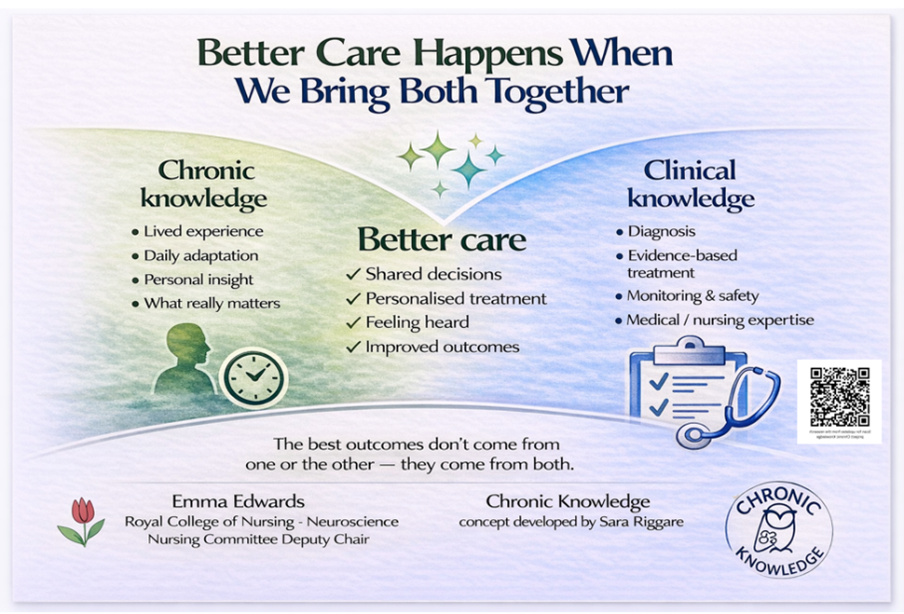
This is where the concept of chronic knowledge becomes particularly important. Researcher and person living with Parkinson’s for over 40 years, Sara Riggare, describes chronic knowledge as the expertise developed through day-to-day experience of living with a long-term condition. It includes subtle symptom awareness, personal priorities, and the practical realities of managing life with Parkinson’s.
The Chronic Knowledge project goes further, aiming to co-create practical recommendations for how patient and healthcare professional expertise can be better integrated into healthcare systems. It moves the conversation beyond theory towards meaningful and sustained change in how care is delivered.
When chronic knowledge is recognised and combined with clinical knowledge — the expertise held by healthcare professionals — the potential for truly personalised care increases. Shared decision making becomes more than a concept; it becomes a lived reality.
Parkinson’s nurses are uniquely placed to help bridge this gap. Their role often allows time for meaningful conversations — the kind that uncover what matters most to individuals. They can translate complex clinical information into understandable options, support self-management, and provide continuity through follow-up.
Parkinson’s UK has long recognised the value of specialist nurses, funding hundreds of roles across the NHS over the years. These roles are not simply supportive — they are central to delivering high-quality, person-centred care.
As nurses, we have an important role in ensuring that shared decision making is not just aspirational but sustained in everyday practice. This means actively seeking out and valuing the chronic knowledge and wisdom of the people we care for and being willing to adapt our clinical approach in response.
So, are we there yet? Progress is evident. But true collaboration requires more than satisfaction with services — it requires a shift in how we view expertise itself.
Better care happens when we bring both together.

 Share on Facebook
 Share on LinkedIn


