
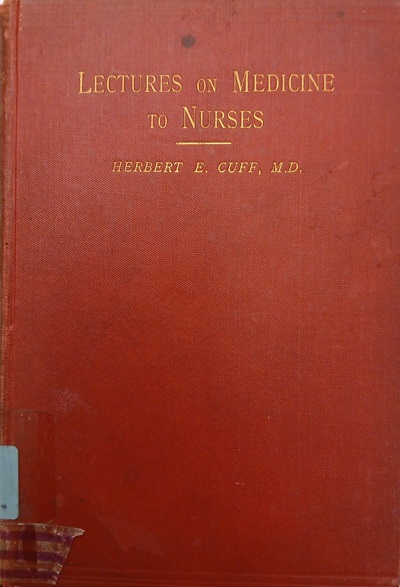
Born in 1864, Herbert Cuff was one of several ‘eminent’ doctors whose lectures reinforced the influence of medicine over the emerging nursing curriculum. First published in 1896, the RCN holds the 1898 second edition of his popular text: ‘Lectures on Medicine to Nurses’, which ran to a seventh edition in 1920.
Nursing textbooks were by no means new, and not all were written by medical men. Most famous is Florence Nightingale’s ‘Notes on Nursing’ published in 1859. Less familiar may be the lectures of the matron of The London Hospital, Eva Luckes, which first went into print in 1884.
Cuff answers the question posed at the start of his book: are nursing textbooks useful or wise? by of course, contending that they are, and addresses the criticisms [then as now!] that nursing has got too academic.
Current nursing texts, he claims, state only the how of nursing, not why each treatment or observation is necessary. He aims to explain each subject, in accurate but simplified scientific language, linking it to nursing observations and practice.
Germs, for example are ‘the smallest living beings with which we are acquainted’ each, like a seed, responsible for a different form of contagion. However, he concedes that for many of the infections the nurse will encounter, such as Smallpox and Measles, the ‘germ’ responsible is still a mystery. Cuff was writing when virology was in its infancy. Scientists deduced there were more ‘germs’ to find but could not yet see them.
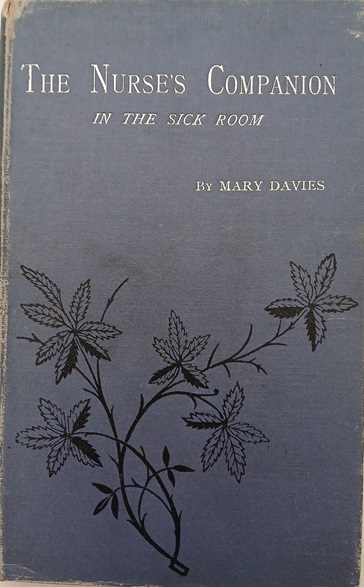
His book focuses on the hospital nurse, but in the late Nineteenth Century, most nursing took place in the patient’s home. Mary Davies’ ‘The Nurses Companion in the Sick Room’, published in 1888, would have been a more valuable volume for a nurse in such circumstances.
It is a very practical ‘how to’ text, full of advice aimed at nurses working in a private house, who might encounter a range of issues, from a serious accident to Scarlet Fever, without the help of hospital equipment, resident doctors or fellow nursing colleagues. For example, how to create a safe sickroom to manage infection, from the first sniffle to fumigating the room at the end. Despite the partial understanding of infection at the time, with a disinfectant - soaked sheet nailed to the door to contain the contagion, her job was to not just care for the patient, but ensure that the whole household, including herself, avoided infection.
Throughout the book Davies’ solution to most problems was ‘use Condy’s fluid’ which sent me off onto an intriguing internet search … Henry Bollmann Condy was a Victorian Chemist, his preparation came in fluid, crystal or powder form, and could be ingested as well as applied externally. It claimed to tackle everything from measles to fungus on trees.
Although the subjects of these books may seem old fashioned, the fundamental principles of nursing management, care and observation remain true today.
Find out more about the RCN Library historical texts and how to access them.

 Share on Facebook
 Share on LinkedIn


