
The event – ‘The fight for the vote: suffragettes and nursing’ – included a presentation from Professor Vari Drennan MBE and Dr Alison O’Donnell about Scottish nurse suffragettes who were arrested between 1906 and 1914. During the research for this presentation, we discovered that a prominent nurse suffragette may have lived in the house that is now 42 South Oswald Road – the RCN Scotland HQ.
Florence Geraldine McFarlane was a nurse and passionate suffragette born in Leith, Edinburgh in 1867/8. It appears that Florence and her family moved to a house on Oswald Road and, when analysing maps and census records from 1881 and 1891, the house, called ‘Glenbourne’, seems to be at the location of the current RCN Scotland HQ. Previous research on the history of our building confirmed it was occupied by a family in the wirecloth industry, and we can corroborate from census records that a McFarlane family in the wirecloth industry lived at Glenbourne with twelve children - including a daughter named Florence.
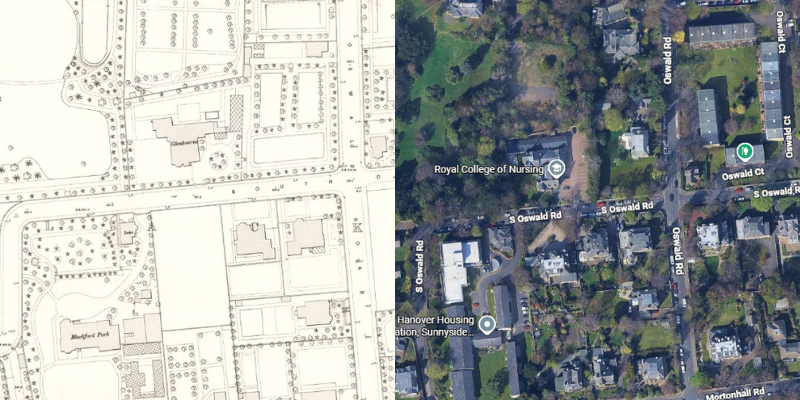
[A map of South Oswald Road in 1895 (CC-BY(NLS)) and today (© Airbus, CNES /Airbus, Maxar Technologies, Map data ©2026 Google.)]
We believe that this is the same Florence McFarlane who later became a nurse, with the 1901 census confirming that she was the matron of a private hospital for women at 2 Archibald Place in Edinburgh.
A member of the Women’s Social and Political Union (WSPU), a militant wing of the British women’s suffrage movement, Florence was arrested and imprisoned in 1910 for participating in what became known as ‘Black Friday’. This was a watershed moment in the WSPU campaign for women’s rights, when 300 suffragettes attempted to storm the House of Commons in London. The police response was violent and hostile, resulting in the arrest of more than 100 suffragettes, who were all released without charge the following day.
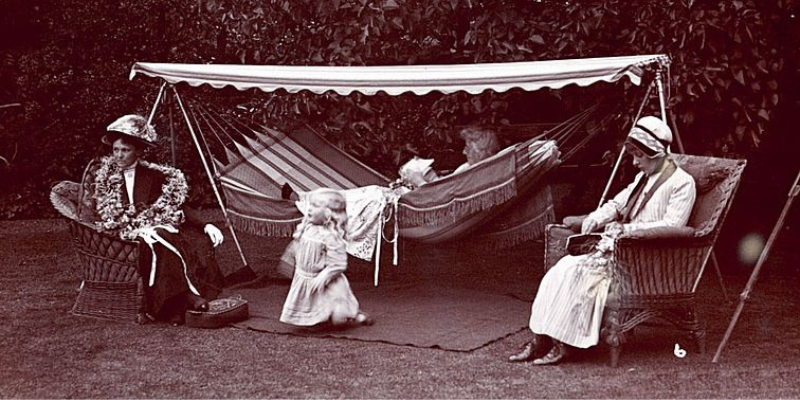
[Florence (right) with fellow suffragettes in London]
In 1912, Florence was imprisoned for four months for breaking a window in protest along with fellow suffragettes. On this arrest, a 1912 newspaper speaks of her: ‘all her life she had been something of a reformer. She was a nurse, and when she found nurses under-fed and under-staffed, she always made her protest.’ At this time, Florence had been living in Dundee, and during her imprisonment, she became known as ‘Dundee’s Hunger-striker’.
In later life, Florence moved to the US where she worked as a journalist and continued to be involved in the campaign for women’s rights.
While more research must be done to confirm that Florence’s childhood home was the building that would become RCN Scotland HQ, much of our initial research points to this being the case. It is certainly an extremely exciting possibility that the RCN Scotland team might be working in the same building where a prominent nurse suffragette used to live.
Watch our 'The fight for the vote: suffragettes and nursing' event recording here.
Learn more about nurse suffragettes at our Prison Nursing Unlocked exhibition, open to the public until 30 September.
Sources:

 Share on Facebook
 Share on LinkedIn


