
The 1st of July 2026 marked the 110th anniversary of the first day of the Battle of the Somme. For me, this has a personal link as my Great Grandfather, Allen Reed, a coal miner who volunteered as a soldier in the Durham Light Infantry, died in this battle. He has no known grave, and his name can be found with over 72,000 others on the Thiepval Memorial in France for those who went missing during this battle. He was 30 when he died and left a wife, a stepson and four children, including my grandmother, Dinah, who was three at the time. She had no memories of him, and she mourned his loss her whole life. I grew up with his photo looking down on me from her sideboard and have always wanted to find out more about his life and death.
The anniversary this year seemed an appropriate moment to go, and I was lucky enough to join a group tour with a knowledgeable and empathic guide, Clive Harris, who found out more for me about him and the circumstances of his death. I also listened to other members of our group sharing their own links to the battle and participated in a special service at the Thiepval Memorial on 1st July. It was very moving to find my Great Grandfather’s name there, amongst so many others.
Whilst I was there, I also reflected on the role that nurses played in this battle and throughout the First World War. At the Beaumont-Hamel memorial site which remembers the contribution (and huge loss of life) of soldiers from Newfoundland (now part of Canada but then a separate dominion), it was good to see a nurse’s face amongst the narratives of Newfoundlanders displayed by the visitors’ centre. Sister Mona (Martha Isabel) Loder came from the tiny settlement of Snook’s Harbour in Newfoundland and served throughout the First World War as a member of the Queen Alexandra’s Imperial Military Nursing Service Reserve (QAIMNSR). She nursed many men from the Battle of the Somme as well as from other battles, working in base hospitals and on ambulance trains. Interestingly, she had trained a nurse in England prior to the war, and I was pleased to discover that she, like me, was a Londoner, i.e. a nurse trained at The London (now Royal London) Hospital.
Sister Edith Appleton, whose diaries I have read, was also a member of the QAIMNSR. She vividly describes the enormous numbers of casualties that came to her hospital on the French coast from the Battle of the Somme. Such was the scale of it she said on July 6th, 1916, ‘I give up trying to describe it – it beats me.’ Train after train arrived at the base hospital where she worked leading to a desperate search for more beds, resulting in them using ‘the lounge of a large restaurant, the orderlies’ barracks, the ambulance garage, the Casino front and part of the officers’ mess.’ It is hard to imagine the magnitude of what she and so many nurses witnessed during their war service.
The number of casualties that this battle created is so enormous it is hard to comprehend. Personal stories such as those of Private Allen Reed and Sisters Mona Loder and Edith Appleton provide humanising insights into the Battle of the Somme, which although it took place 110 years ago, still resonates today.
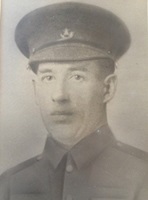
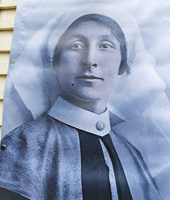
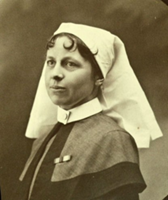
From left to right: Private Allen Reed, Sister Mona Loder and Sister Edith Appleton
Picture sources
- Allen Reed from author’s personal collection.
- Mona Loder taken by Elizabeth Mason-Whitehead from a banner outside the visitor centre at the Beaumont-Hamel memorial site
- Edith Appleton source Dick Robinson, her great nephew. For Edith’s diaries see Cowen R. (ed) A Nurse at the Front: The First World War Diaries of Sister Edith Appleton. (London, Simon and Schuster: 2012).

 Share on Facebook
 Share on LinkedIn


