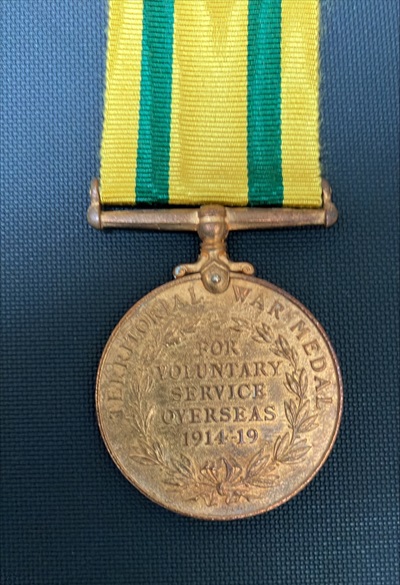
I am a keen amateur family historian who enjoys finding out the stories of individual women, especially those who were involved in the First World War. Through this, I was gifted a Territorial Force Nursing Service (TFNS) medal which led me to discover Harriet Maud Goulder.
Harriet was born in Sheffield in 1879, one of eight children. Sadly, her parents died when she was 14, and she became a shop assistant before becoming a nurse. Two of her sisters also became nurses. She trained in Rotherham, before working in Keighley and London. About 18 months before the First World War started, she joined the TFNS.
When war broke out Harriet was called to active duty, first in Birmingham, and then in July 1916 in Salonika. By October she had contracted malaria and its recurrence forced her to return to work in Birmingham. Harriet subsequently requested a move to Portsmouth, but in July 1918, after five hospital boards, it was agreed that she would be discharged as the malaria made her permanently unfit for duty. At several of the boards she had argued to remain on duty! After the war she married and continued to nurse.
As well as her TFNS war medal, she was awarded a Silver War Badge medal, given to 438 TFNS who were disabled or chronically ill following their service. I was struck by how committed Harriet was to her profession as a nurse. I was also struck by just how many nurses became chronically sick during the war, and how little they were offered in terms of compensation.
I am delighted that this medal is now going to be where it deserves to be - in a collection dedicated to the nursing profession that she served so well, supported by members who are passionate about the history of nursing.
Read more about Harriet in my blog.
Harriet's service record is one of the ones that survive and is available online in The National Archives (WO 399).

 Share on Facebook
 Share on LinkedIn


