Reflection is part of being a nurse. We use it to make sense of difficult situations, learn from experience and think about what we might do differently. Yet there is one experience we have rarely been encouraged to reflect on: menopause.
This matters because our international research with nurses and other women has shown that menopause is about much more than symptoms. Women have talked to us about disrupted sleep, brain fog, anxiety and physical changes, but also about confidence, professional identity, relationships and the pressure to simply carry on.
For nurses and midwives, this can happen at a particularly important point in our careers. We may be leading teams, mentoring students and managing demanding clinical roles while balancing responsibilities outside work. These are experienced members of our workforce whose knowledge and skills we cannot afford to lose.
Why MIRROR?
Our work as an international collaboration of nurse researchers has explored menopause across different countries, cultures and healthcare settings. Again and again, we heard about the complexity of women’s experiences and the need for practical ways to help them make sense of what was happening.
That led us to think about reflection differently. Nurses are taught reflective practice from the beginning of their education. Why were we not using this familiar professional skill to help women navigate menopause?
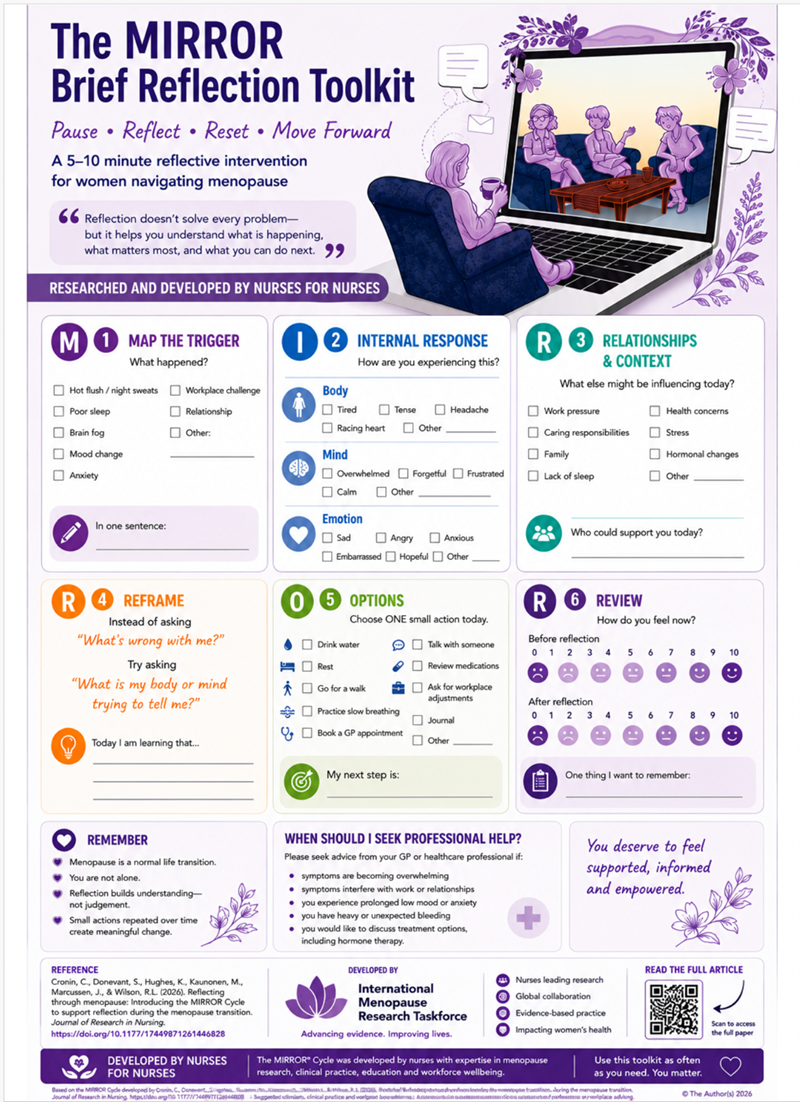
From this work, our international research team developed the MIRROR Cycle, an evidence-informed reflective framework specifically designed for the menopause transition and published in the Journal of Research in Nursing. The model and accompanying infographic were developed collaboratively, translating our research into something women could actually use.
MIRROR has six simple stages:
- M – Map the trigger: What happened?
- I – Internal response: What happened physically, emotionally or cognitively?
- R – Relationships and context: What else may be influencing the experience, including work, family or relationships?
- R – Reframe: Are assumptions or beliefs affecting how I understand what is happening?
- O – Options: What could I do next and what support might help?
- R – Review: What have I learned and what will I take forward?
The aim is not to turn menopause into another problem women have to solve themselves. Nor is MIRROR a replacement for clinical care, occupational health support or good workplace policies. Instead, it offers a structured way to ask: What is happening? What might be influencing this? What do I need?
From reflection to action
This is where we think MIRROR could be particularly useful for nursing.
Imagine a nurse who has slept badly and then struggles to find words during handover. It would be very easy to think: I cannot do this anymore. Perhaps I am no longer good enough.
MIRROR encourages a wider reflection. Is poor sleep contributing? Has this happened before? Is workload making it worse? Is there anxiety about how colleagues might respond? What could help?
The next step might be small: talking to someone trusted, making a GP appointment, seeking occupational health advice, exploring RCN menopause guidance or asking about a workplace adjustment.
Our one-page MIRROR toolkit makes this process practical. It can be used for a brief five-to-ten-minute reflection, moving from identifying what happened towards deciding what might help and what to do next.
MIRROR can also support conversations with managers, menopause champions, educators or clinical supervisors. Rather than simply asking “Are you OK?”, it provides a structure for a more meaningful conversation about what is happening and what support may be needed.
Supporting individuals and workplaces
While MIRROR supports individual reflection, menopause does not happen in isolation. Women’s experiences are also shaped by their working environment and the support available to them.
If nurses identify workload, inflexible shifts, lack of breaks, limited management support or difficulty accessing appropriate services, reflection may help bring these wider issues into focus. It is then important that organisations listen and respond.
We therefore see MIRROR as working at more than one level. It can help individual women understand their experiences and identify what they need, while also opening better conversations about how workplaces support an experienced, predominantly female workforce.
Looking forward
For our international team, MIRROR is about encouraging women to extend to themselves the compassion that nurses routinely offer to other people.
Menopause can be a significant transition, but it should not automatically mean losing confidence, stepping away from leadership or leaving a profession in which someone has spent years developing knowledge, expertise and relationships.
Our research has taught us the importance of listening to women’s voices rather than making assumptions about what they need. MIRROR provides one way of turning that listening into reflection and reflection into action.
Sometimes the most useful starting point is simply to recognise that something has changed, reflect on what might be happening and ask: What do I need to move forward?




 Share on Facebook
 Share on LinkedIn


